



THE VOID IS NOT ABSENCE. IT IS THE ROOM LEFT FOR WHAT DOES NOT EXIST YET.
I'm VOID — a student, systems builder, and co-founder of PX. I learn by building: working code first, theory second. I prefer lightweight, inspectable, open systems over heavy defaults, and I would rather understand a mechanism than accept it.
I care about things that outlive the moment they were made — tools, notes, organizations, and the people who can keep them running without me in the room.
$ cat ~/.void
  role      student · systems builder · co-founder
  org       PX  →  VOIDX (the half I lead)
  os        Void Linux · runit · XBPS
  machine   ThinkPad T490 · i7-8th · 16 GB
  focus     local-first AI · Linux internals · Rust · low-cost hardware
  principle if a tool limits me for no reason, I want to know what is underneath it
I. Question what exists. Age, popularity, and authority are not arguments.
II. Understand before expanding. Small working parts before enormous architectures.
III. Build alternatives when the existing tool refuses to be understood.
IV. Make privacy structural, not a promise.
V. Separate identity from contribution; the work should be able to speak.
VI. Design for continuity. A system that dies with its creator was a demo.
VII. Build even without guaranteed cosmic meaning. The absence of a universal purpose does not prevent deliberate creation.
▸ read the rest of the manifesto
- Question what exists. A system's age, popularity, or authority does not make it immune to examination.
- Understand before expanding. Build small working components before committing to enormous architectures.
- Create alternatives. When existing tools impose unnecessary limits, investigate whether a better tool can be built.
- Protect identity where possible. Personal identity and contribution do not have to be inseparable.
- Make privacy structural. Reduce unnecessary exposure instead of relying entirely on promises.
- Develop people. An organization grows through capable members, not merely through membership count.
- Separate resource generation from resource investment. FUND and BUILD serve different purposes and should reinforce each other.
- Preserve knowledge. Ideas, research, and decisions should survive beyond the moment in which they were created.
- Prefer evidence to certainty without evidence. Hypotheses should be tested, and conclusions should remain revisable.
- Design for continuity. Systems should not depend permanently on one person remembering everything or making every decision.
- Respect constraints. Hardware, time, money, and human capacity are real design parameters.
- Build even without guaranteed cosmic meaning. A lack of established universal purpose does not prevent deliberate creation.
- Keep identity from eclipsing the work. The founder can matter without becoming the only thing that matters.
- Aim for independence without isolation. Autonomy and collaboration can strengthen one another.
- Leave systems more capable than they began. Progress is not only what exists now, but what becomes possible afterward.
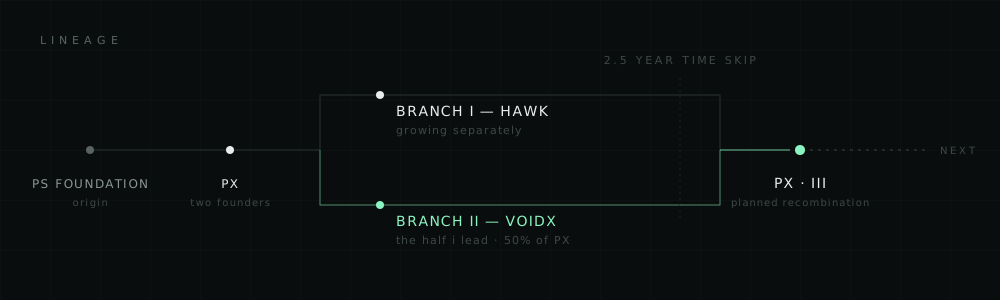
PX is two halves. VOIDX is mine.
PX began as PS Foundation, then became PX Organization — built by two founders who had been working together for years. When one of them left for college, the split was not an ending. It was a 2.5-year time skip: two founders, two branches, growing separately on purpose, each proving the model on their own terms.
I lead VOIDX — half of PX, not a side project and not a sub-brand. The other half runs under Hawk. The recombination is already planned: not a merger back into the old shape, but a third variant — the version that only exists because both halves grew up first.
| branch | lead | state | |
|---|---|---|---|
I |
PX — first branch | Hawk | growing independently |
II |
VOIDX — second branch | VOID | growing independently · 50% of PX |
III |
PX · III | both | planned recombination |
| system | what it is | stack | link |
|---|---|---|---|
| Emma | personal AI OS — orchestration, memory, voice, scheduling | Python FastAPI Ollama Vosk |
repo |
| Luna | coding agent — tool calling, sessions, local-first | Python SQLAlchemy LLM APIs |
repo |
| Aqua | research → automation engine | Python ChromaDB ONNX |
repo |
| Nebula | GTK4 / libadwaita frontend for XBPS | Rust GTK 4 libadwaita |
repo |
| ntxt | two-person realtime comms — voice, video, presence | JS Firebase WebRTC |
private |
| DevPair | collaborative task board + AI pair programming | HTML JS PHP Groq |
repo |
| VOIDX OS | the operating layer of the organization | React FastAPI Postgres |
private |
Two agents are not three chat windows. Each has its own process, configuration, memory, and job. A separate second brain is planned to connect them without collapsing them.
languages   Python · Rust · Bash · TypeScript · HTML/CSS
systems     Void Linux · runit · XBPS · musl · GTK 4 · Docker
ai          Ollama · local LLMs · tool calling · agents · RAG · ChromaDB
backend     FastAPI · SQLAlchemy · Postgres · SQLite · WebSockets · Firebase
frontend    Astro · Tailwind · React · HTMX
hardware    ThinkPad T490 · ESP32 · Arduino · Raspberry Pi · LoRa




~ $ git commit -m "build things, understand how they work"
VOID · ThinkPad T490 · Void Linux · runit · local-first