Repository navigation
Home
Welcome to the Wiki page of SpacePath!
This is a comprehensive guide to using SpacePath for the functional-centric analysis of spatial metabolomics and lipidomics (Figure 1). You will find structured documentation to help you get started, run analyses, and troubleshoot with ease.
SpacePath isn’t just a tool—it’s a versatile framework that integrates seamlessly into your custom pipelines and Jupyter notebooks.
The modular design of its core library lets you seamlessly extend, adapt, and integrate with external spatial omics packages, enabling users to build tailored workflows, explore data interactively, or embed SpacePath into larger projects💡.
This guide assumes that you have already installed SpacePath as specified in its README.
Important
When using SpacePath, please cite our preprint:
Galvis J, Moreau M, Lillo S, Bomont D, Ledoux L, Zirem Y, Salzet M, Fournier I, Desbenoit N, Daubon T, & Nikolski M (2026). SpacePath enables pathway and molecular-family analysis beyond annotation ambiguity in spatial metabolomics and lipidomics. bioRxiv. https://www.biorxiv.org/content/10.64898/2026.10.16.759546v1
| Section | Description |
|---|---|
| 🚀 Getting Ready | Modalities of use of SpacePath and how to access example datasets. |
| 💻 Command-Line Usage | Run SpacePath from the terminal for seamless analyses. |
| 📦 Library Usage | Use SpacePath as a Python library to integrate it into your workflow. |
| 📦 Supplementary Information | Handle special cases with the SpacePath core library. |
| ❓ Getting Help | Find support, FAQs, and troubleshooting tips. |
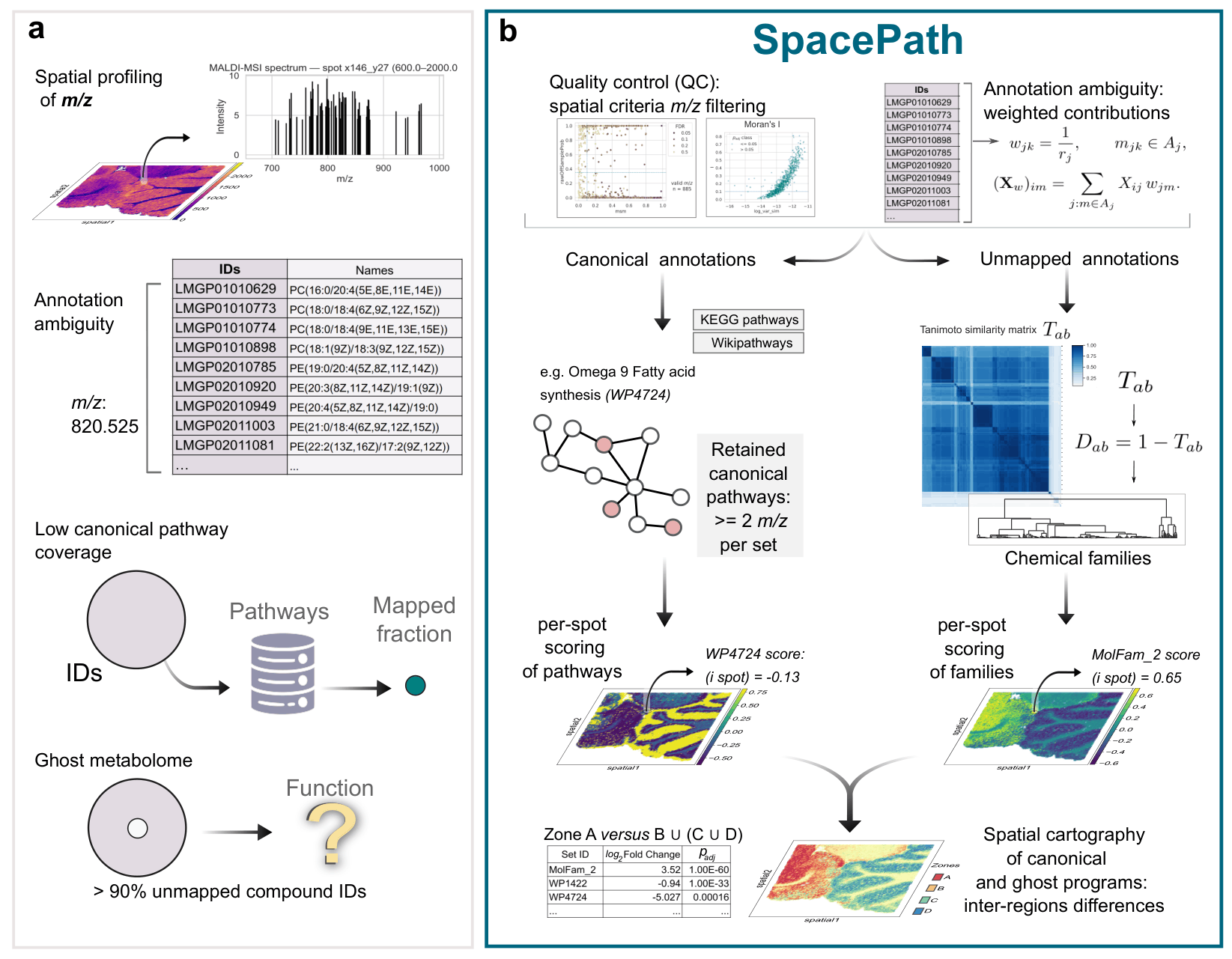
MSI-based metabolomics/lipidomics data exhibit unresolved isomerism and low pathway coverage, giving rise to the 'ghost metabolome' problem (a). SpacePath (b) addresses annotation ambiguity for per-spot scoring of pathways, and rescues the ghost metabolome through candidate chemical families, offering a unified framework for the spatial cartography of potential metabolic programs.
SpacePath is available at PyPI 🎉